Skills You Learn During a Dermatology Fellowship
Med Fellow Academy
Medical Education Experts
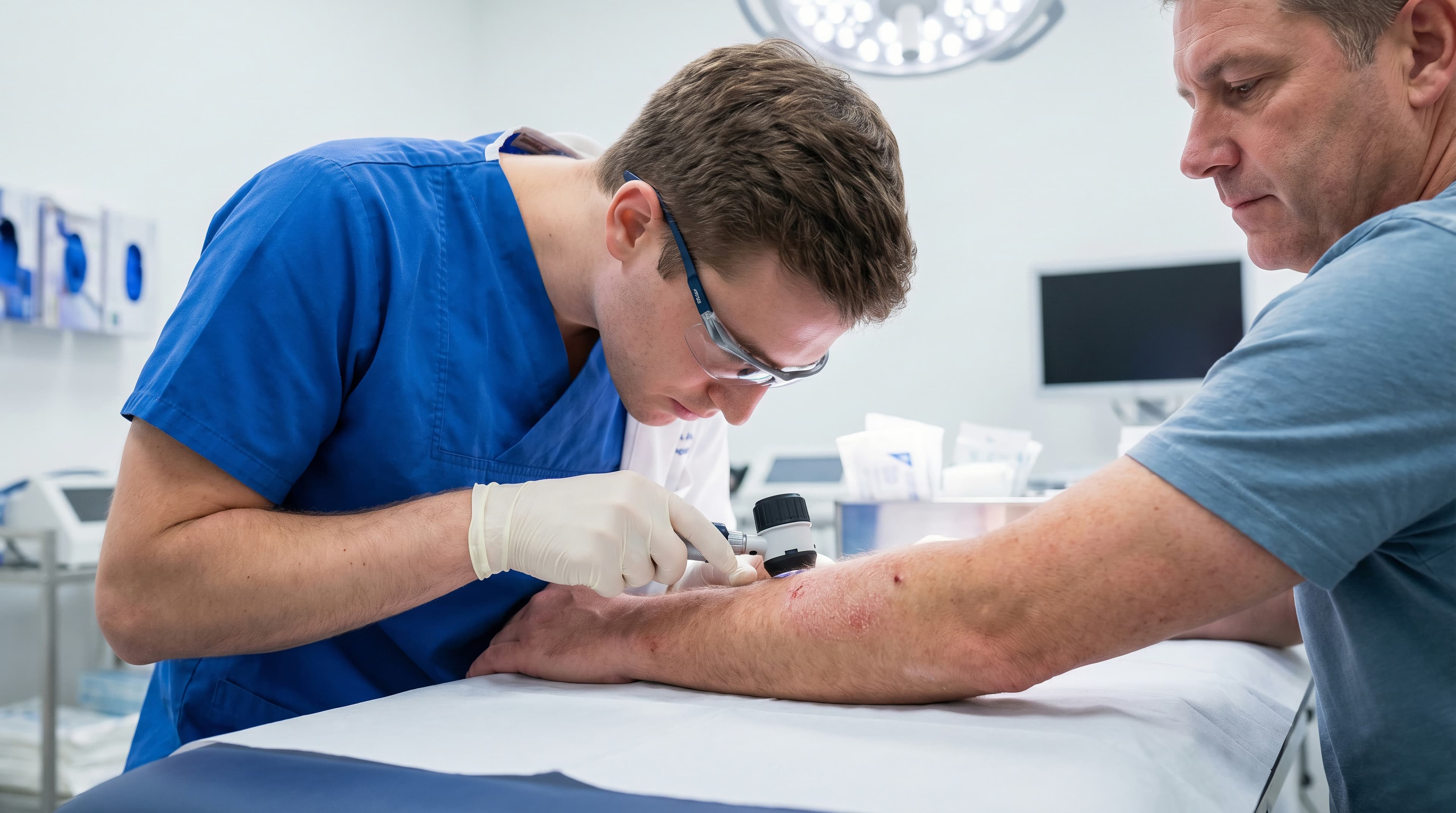
What looks like a simple skin rash can sometimes represent infection, inflammation, allergy, an autoimmune condition, or even an underlying systemic disease. Good dermatology is not simply about recognizing a few common skin conditions — it requires a structured approach to skin examination, lesion recognition, differential diagnosis, investigation, treatment planning, procedures, and patient communication. A well-designed fellowship can help doctors develop these skills through structured learning, clinical cases, demonstrations, assessments, and, where included, clinical exposure.
12 Skill Areas Developed in Fellowship Training
Skin Examination Skills
Recognizing primary and secondary lesions (macules, papules, plaques, nodules, vesicles, pustules, wheals, ulcers, crusts, scales), assessing distribution and pattern (localized or generalized, symmetrical or asymmetrical, flexural or extensor, photo-distributed, dermatomal), and examining skin, hair, nails, and mucosal surfaces together.
Clinical Diagnosis and Differential Diagnosis
Moving from what you see to why it is happening — comparing history, morphology, distribution, associated symptoms, differential diagnosis, investigation, and treatment. Connecting skin findings with systemic disease, recognizing red flags, and developing a repeatable way of thinking through an unfamiliar presentation.
Dermoscopy and Diagnostic Skills
Understanding basic dermoscopic principles and patterns, evaluating pigmented and suspicious lesions, improving diagnostic confidence alongside history and examination, and knowing when clinical examination and dermoscopy are sufficient versus when additional investigation or referral is appropriate. It should not replace clinical judgment or histopathology when indicated.
Inflammatory and Autoimmune Dermatology Skills
Recognizing atopic and contact dermatitis, psoriasis, urticaria, lichen planus, seborrheic dermatitis, and other inflammatory dermatoses; understanding disease patterns (itching, scaling, erythema, recurrent flares); considering trigger factors (medications, occupation, cosmetics, allergens); and understanding long-term management, follow-up, and adherence.
Infectious and Tropical Dermatology Skills
Recognizing common fungal, bacterial, viral, and parasitic infections and tropical dermatoses; differentiating infection from inflammation; understanding appropriate investigations (microscopy, cultures); and improving treatment planning based on likely organism, severity, patient factors, and previous treatment.
Hair and Nail Disorder Skills
Evaluating hair loss (pattern hair loss, alopecia areata, telogen effluvium, scarring alopecia, hair shaft disorders), performing a structured scalp examination, recognizing nail changes associated with fungal infections, psoriasis, trauma, and systemic disorders, and building a structured work-up.
Aesthetic and Cosmetic Dermatology Skills
Assessing common cosmetic concerns (acne scars, pigmentation, uneven skin tone, fine lines, photoaging, texture, unwanted hair), matching treatment to patient concern and skin characteristics, managing patient expectations, and understanding combination approaches.
Laser and Procedural Dermatology Skills
Understanding laser principles (wavelength, target tissue, energy delivery, pulse duration, parameters, skin response), common applications (pigmentation, vascular lesions, acne scars, hair reduction, rejuvenation), patient selection factors, and safety and complications. Practical laser competency requires appropriate supervised clinical training rather than theoretical study alone.
Patient Management Skills
Taking a focused dermatology history (onset, duration, progression, symptoms, previous treatments, medications, allergies, family history, occupational exposure, lifestyle), explaining the diagnosis clearly, setting realistic expectations for chronic conditions and aesthetic treatments, and planning follow-up.
Clinical Decision-Making Skills
Prioritizing the most important problem, balancing benefit and risk (diagnosis, severity, age, comorbidities, pregnancy, medications, patient preferences, expected benefit, adverse effects), knowing when to refer (biopsy, specialist referral, multidisciplinary evaluation, urgent treatment, systemic investigation), and using evidence to support decisions.
Case-Based Reasoning Skills
Connecting theory with practice, comparing similar conditions, learning from diagnostic errors and treatment complications, and developing confidence with unfamiliar cases through a repeatable approach when the diagnosis is not immediately obvious.
Academic and Professional Skills
Literature review, structured case presentation, clear clinical documentation, patient education (treatment plans, skin-care routines, medication use, prevention, follow-up), and the habit of lifelong learning in a rapidly evolving field.
Skills Checklist Before Choosing a Fellowship
| Skill Area | What to Look For |
|---|---|
| Skin examination | Lesion morphology and systematic examination |
| Clinical diagnosis | Differential diagnosis and clinical reasoning |
| Dermoscopy | Dermoscopic patterns and lesion assessment |
| Inflammatory dermatology | Eczema, psoriasis, dermatitis and related disorders |
| Infectious dermatology | Fungal, bacterial, viral and tropical conditions |
| Hair disorders | Hair loss and scalp assessment |
| Nail disorders | Nail examination and common disorders |
| Aesthetic dermatology | Cosmetic assessment and treatment principles |
| Laser therapy | Laser principles, indications and safety |
| Skin procedures | Procedural principles and appropriate exposure |
| Patient management | Counseling, follow-up and treatment planning |
| Critical thinking | Red flags, referrals and complex cases |
| Research | Literature review and evidence-based practice |
The most important question is not simply "How many topics are included?" Ask: "How are these skills taught, practiced, and assessed?"
Fellowship Learning vs Clinical Competency
Learning a Procedure
Studying the indications, contraindications, equipment, technique, and complications.
Observing a Procedure
Valuable clinical context, but not equal to independent procedural competency.
Performing Under Supervision
Requires appropriate supervision, patient selection, clinical environment, and assessment.
Practising Independently
Depends on formal qualifications, demonstrated competence, professional registration, institutional credentialing, scope of practice, and applicable regulations.
A fellowship should be evaluated based on what it genuinely provides rather than assuming that completion automatically establishes independent procedural competency.
Which Dermatology Skills Should You Prioritize?
The most useful skills depend on what you want to do after training. For general clinical dermatology: examination, diagnosis, differential diagnosis, inflammatory disorders, infectious diseases, and patient management. For aesthetic dermatology: cosmetic assessment, patient selection, treatment planning, lasers, procedures, complication awareness, and expectation management. For hair and nail practice: scalp examination, hair-loss patterns, nail disorders, investigations, and treatment planning. For academic growth: research methodology, evidence appraisal, case presentation, literature review, and teaching skills. For working doctors: a flexible learning model matters, but it should still provide clear learning outcomes and an appropriate practical pathway for the skills being taught.
Career Opportunities After a Dermatology Fellowship
Completing a Fellowship in Dermatology can support professional development in several areas, depending on your existing medical qualification, experience, scope of practice, employer, and applicable regulations:
A fellowship certificate is different from a formal specialist qualification. Completing a fellowship does not automatically confer specialist registration, independent procedural privileges, or specialist status. Hands-on procedural practice should be obtained through appropriate supervised clinical training.
Build Skills That Improve Diagnosis
Explore the MedFellow Academy Fellowship in Dermatology and review the curriculum, training format, eligibility, and course structure. Ask how each skill is actually taught and assessed.
About Med Fellow Academy
MedFellow Academy provides structured, flexible fellowship courses for practicing doctors — combining evidence-based curriculum, expert faculty mentorship, and hands-on clinical training across 60+ specialties.